


MRAB approaches every engagement by starting from the organisation’s objectives and from the value that ICT can generate for the business.
To support our engagements, we use our own methodological framework, developed over time through the consulting and project experience gained by Malabo and MRAB, and continuously updated in line with leading international standards, frameworks and best practices.
The framework is not a rigid model: it is adapted to the Client’s characteristics, size, culture and specific needs and, where appropriate, integrated with methods and tools already in use.
Guiding principles
Our approach is based on a number of principles that guide every engagement, regardless of the size and complexity of the organisation.
Business before technology
ICT is not an end in itself, but a means of supporting the organisation’s objectives, processes and activities.
A holistic perspective
Every issue is considered within the broader context of ICT governance and management, avoiding isolated or purely technical approaches.
Standards applied pragmatically
International frameworks, standards and best practices are selected and contextualised to the Client’s specific environment, rather than applied mechanically.
Value and knowledge transfer
Engagements should deliver tangible and, wherever possible, measurable results, while also leaving the Client with skills, methods and operational capabilities.
These principles form the basis of the methodological framework MRAB uses to structure and guide its engagements.
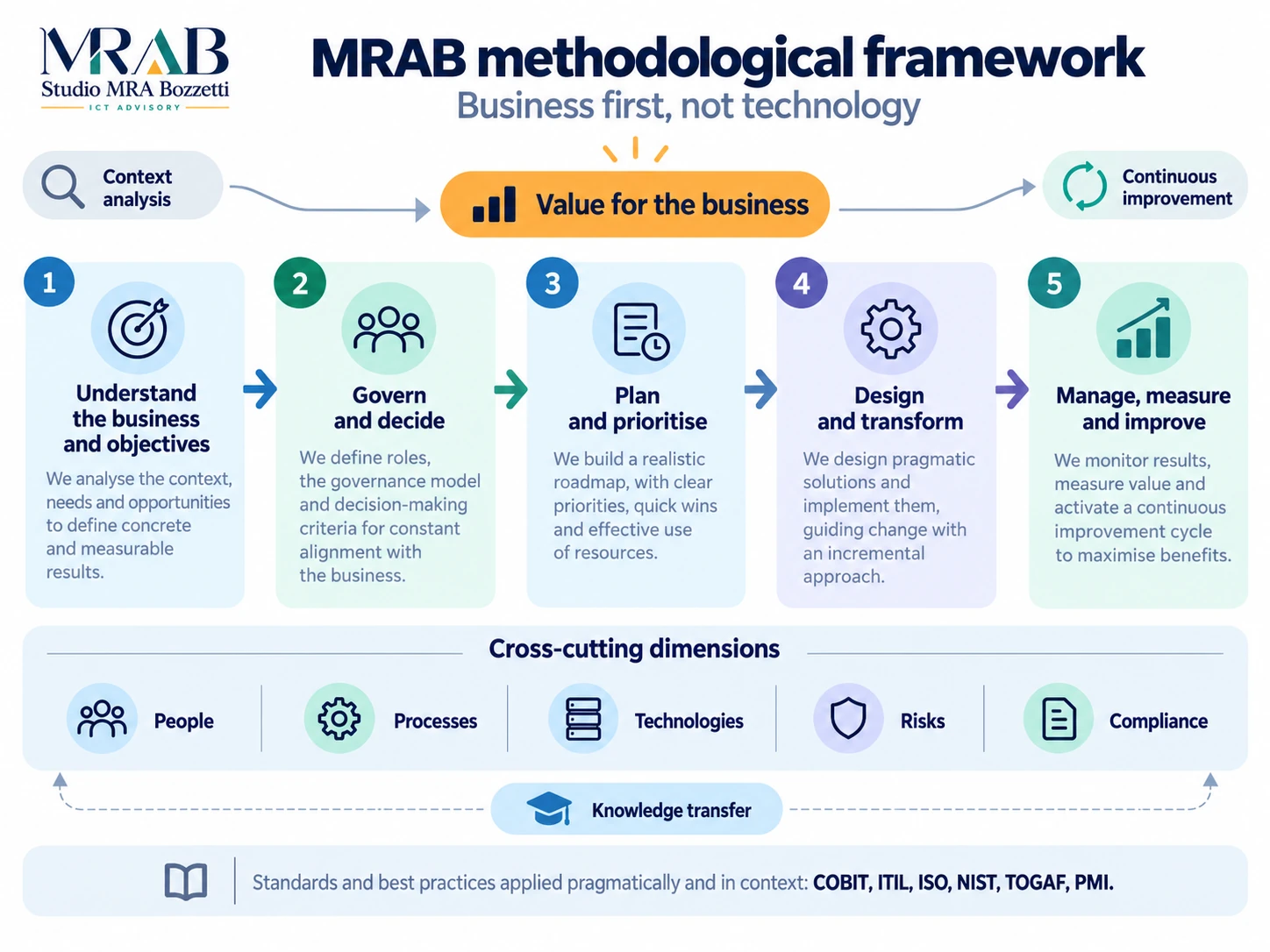
The MRAB framework integrates business objectives, governance, planning, transformation, management and continuous improvement.
How it works in practice
The framework is applied flexibly to the Client’s specific needs. Depending on the engagement, the different phases may include, for example:
Govern and decide
Governance model · roles and responsibilities · risk · stakeholders
Plan and prioritise
Priorities · roadmap · sourcing · skills
Design and transform
Design · solution selection · project governance · change
Manage and protect
ICT services · suppliers · cybersecurity · continuity
Measure and improve
KPIs · SLAs · audit · assessment · improvement plans
